

Dr. King's Assassination
- Title:
- Dr. King's Assassination
- Years:
- 1968
- Description:
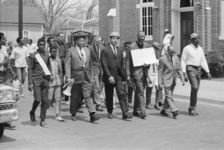
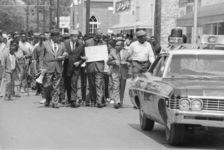
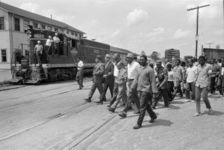
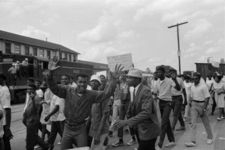
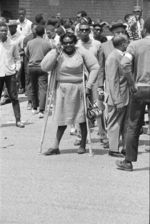
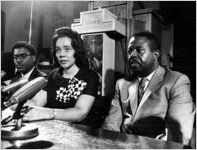
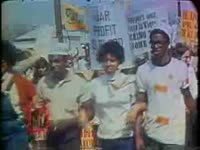
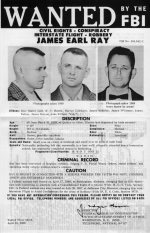
- On April 4, 1968, Martin Luther King, Jr. was assassinated by a sniper's bullet while standing on the second-floor balcony of his room at the Lorraine Motel in Memphis, Tennessee. As news of King's death spread, violent riots broke out in African American neighborhoods in over one hundred cities across the United States. King, who was the nation's foremost civil rights leader, had returned to Memphis to lead a nonviolent march in support of the city's striking sanitation workers. On April 8, King's widow, Coretta Scott King, and the couple's four small children led a crowd estimated at forty thousand in a silent march through the streets of Memphis to honor the fallen leader and support the cause of the city's black sanitation workers. The next day, funerary rites for King were held in his hometown, Atlanta, Georgia. Following a nationally televised broadcast of his funeral service at Ebenezer Baptist Church, King's body was led three-and-a-half miles through the city's streets, with more than one hundred thousand mourners in tow, to Morehouse College where a second funeral service was performed. King's assassin, James Earl Ray, was apprehended by authorities in London, England after a two-month international manhunt. Upon his extradition to Tennessee, Ray pleaded guilty to the murder of Martin Luther King, Jr. and was given a ninety-nine year jail sentence.
- Archival Collections And Reference Resources:
-
84 items in 15 collections (expand all)
- Educator Resources:
-
2 items in 2 collections (expand all)
![--It's th' James Earl Ray case!-- / Baldy, [1973].](https://crdl.usg.edu/thumbnails/dlg/bald/dlg_bald_ph-780.jpg)
![--Just for this one single day-- / Baldy, [1968].](https://crdl.usg.edu/thumbnails/dlg/bald/dlg_bald_am-512.jpg)
![--MLK-- ? / Baldy, [1968 Apr. 5].](https://crdl.usg.edu/thumbnails/dlg/bald/dlg_bald_ph-354.jpg)
![--Nonviolence!-- Nonviolence!-- Nonviolence!-- / Baldy, [1968].](https://crdl.usg.edu/thumbnails/dlg/bald/dlg_bald_ph-433.jpg)


![[Birthday card from Douglas M. Herrera to John J. Herrera - 1968-04-11]](https://crdl.usg.edu/thumbnails/int/jjhp/int_jjhp_248554.jpg)