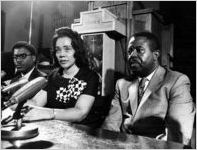


Memphis Sanitation Workers Strike
Background:
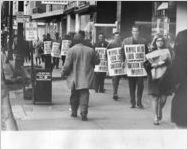
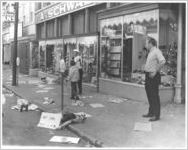
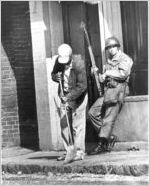
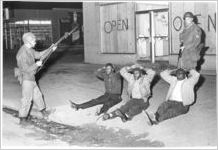
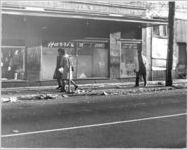
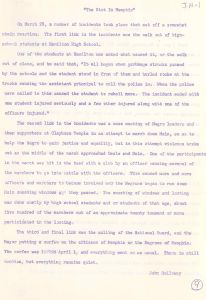
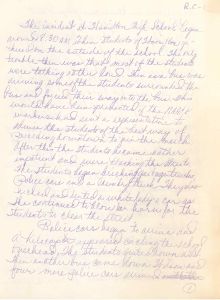
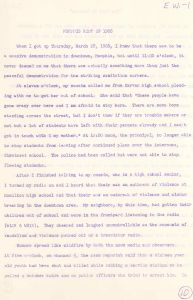
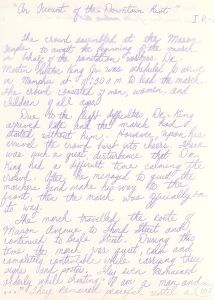
Longstanding tensions between disgruntled African American sanitation workers and Memphis city officials erupted on February 12, 1968 when nearly one thousand workers refused to report to work demanding higher wages, safer working conditions, and recognition of their union, local 1733 of the American Federation of State, County, and Municipal Employees. Despite organizing city-wide boycotts, sit-ins, and daily marches, the city's sanitation workers were initially unable to secure concessions from municipal officials. At the urging of Reverend James T. Lawson, Martin Luther King, Jr. agreed to come to Memphis and lead a nonviolent demonstration in support of the sanitation workers. On March 29 over five thousand demonstrators, carrying signs which read "I Am A Man," participated in King's march. However, the peaceful demonstration took a turn for the worse when an estimated two hundred participants began breaking storefront windows and looting. The ensuing violence resulted in the death of Larry Payne, a sixteen year old African American who was killed by Memphis police officers, the imposition of a city-wide curfew, and the mobilization of nearly four thousand National Guard troops. Deeply troubled by the violent outbreak, King vowed to return to Memphis to lead a peaceful demonstration. On April 3, 1968, nearly two months after the initial start of the strike, King returned to Memphis and delivered what would be his last public speech. The following evening King was assassinated on the second-floor balcony of the Lorraine Motel. In the wake of King's death, President Lyndon B. Johnson sent James Reynolds, undersecretary of labor, to Memphis to help resolve the strike. Nearly two weeks later on April 16, the Memphis sanitation workers' strike ended when the city agreed to issue raises to African American employees and recognize the workers' union.
Expand all | Collapse all | Results view
Archival Collections and Reference Resources
- 1968 Sanitation Workers Strike (University of Memphis. Special Collections Dept.)
- Audience (Black-and-white photographs)
- Audience at Mason Temple (Black-and-white photographs)
- Beale and Hernando (Black-and-white photographs)
- Beale St. (Black-and-white photographs)
- Beale St. riot (Black-and-white photographs)
- Booker T. students arrested (Black-and-white photographs)
- Crowd (Black-and-white photographs)
- Curfew Violators (Black-and-white photographs)
- Democrat Road (Black-and-white photographs)
- Dr. Ralph Jackson and Sam Evans (Black-and-white photographs)
- Fire (Black-and-white photographs)
- Garbage Strike (Black-and-white photographs)
- Joseph Pasley [Paisley] and T.O. Jones (Black-and-white photographs)
- Loeb and Sanitation Workers (Black-and-white photographs)
- Looter (Black-and-white photographs)
- Main Street (Black-and-white photographs)
- March (Black-and-white photographs)
- March on Main and Beale (Black-and-white photographs)
- Marchers (Black-and-white photographs)
- Martin Luther King, Jr. (Black-and-white photographs)
- Mayor Loeb (Black-and-white photographs)
- MLK at Mason Temple (Black-and-white photographs)
- National Guardsman (Black-and-white photographs)
- People running (Black-and-white photographs)
- Police (Black-and-white photographs)
- Police in riot gear (Black-and-white photographs)
- Police on Beale St. (Black-and-white photographs)
- Policemen (Black-and-white photographs)
- Protesters (Black-and-white photographs)
- Protesters at Clayborn Temple (Black-and-white photographs)
- Rev. James Lawson (Black-and-white photographs)
- Riot (Black-and-white photographs)
- Rioting (Black-and-white photographs)
- Sanitation Strike (Black-and-white photographs)
- Sanitation Strike March (Black-and-white photographs)
- Sanitation strike - Police (Black-and-white photographs)
- Sanitation Strike Protest (Black-and-white photographs)
- Sanitation Workers Marching (Black-and-white photographs)
- Sanitation Workers Strike (Black-and-white photographs)
- Street scene (Black-and-white photographs)
- Strikers (Black-and-white photographs)
- Strikers and Loeb (Black-and-white photographs)
- Strikers and scabs (Black-and-white photographs)
- Strikers Outside Clayborn Temple (Black-and-white photographs)
- T.O. Jones (Black-and-white photographs)
- Thomas Moore (Black-and-white photographs)
- Vance and Fourth (Black-and-white photographs)
- William Lucy, P.J. Chiampa, Jerry Wurf (Black-and-white photographs)
- Encyclopedia of Alabama (Encyclopedia of Alabama)
- Gilder Lehrman Institute of American History: The Collection (Gilder Lehrman Institute of American History)
- New Georgia Encyclopedia (New Georgia Encyclopedia)