

John F. Kennedy's Assassination
- Title:
- John F. Kennedy's Assassination
- Years:
- 1963
- Description:
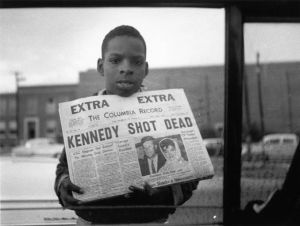
- On November 22, 1963 President John F. Kennedy was assassinated while traveling through Dallas, Texas, in a presidential motorcade. Shortly after the shooting, Lee Harvey Oswald was apprehended and charged with the president's murder. Kennedy's assassination threatened to slow the growing momentum of the Civil Rights movement. While the first years of his presidency were largely overshadowed by the Cold War, President Kennedy publicly committed his administration to the cause of racial equality in the summer of 1963 when he proposed a Civil Rights bill to Congress and offered his endorsement to the March on Washington for Jobs and Freedom. Kennedy's successor, Lyndon B. Johnson signed the Civil Rights Act into law on July 2, 1964.
- Archival Collections And Reference Resources:
-
16 items in 6 collections (expand all)
![--No, things are about the same! / Baldy, [ca. 1968]](https://crdl.usg.edu/thumbnails/dlg/bald/dlg_bald_am-2265.jpg)
![Profiles in courage / Baldy, [1963]](https://crdl.usg.edu/thumbnails/dlg/bald/dlg_bald_ph-464.jpg)


![[Draft of "They have killed my president!"]](https://crdl.usg.edu/thumbnails/int/jjhp/int_jjhp_249203.jpg)
![[Draft of "They have killed my president!"]](https://crdl.usg.edu/thumbnails/int/jjhp/int_jjhp_249200.jpg)
![[Letter from John J. Herrera to J. Carlos McCormick - 1963-11-29]](https://crdl.usg.edu/thumbnails/int/jjhp/int_jjhp_249199.jpg)
![[Letter from John J. Herrera to John B. Connally - 1964-01-11]](https://crdl.usg.edu/thumbnails/int/jjhp/int_jjhp_249251.jpg)
![[Letter from John J. Herrera to John B. Connally - 1964-01-11]](https://crdl.usg.edu/thumbnails/int/jjhp/int_jjhp_249252.jpg)