

Brown versus Board of Education
Background:
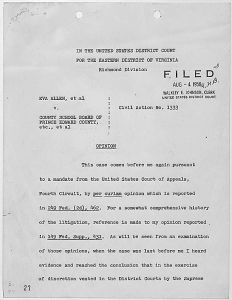
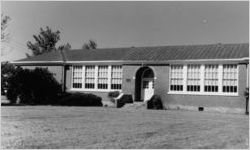
The U.S. Supreme Court's ruling in Brown v. Board of Education was a watershed event in the history of the United States. The landmark ruling had it roots in Topeka, Kansas, in 1951 when, Oliver Brown, an African American minister and welder, called upon the local branch of the National Association for the Advancement of Colored People (NAACP) for legal assistance after the city's school board refused to enroll his daughter in an all-white school. The class action lawsuit, filed by Brown and nearly twenty others, ended in the U.S. District Court's ruling in favor of the Board of Education. Undaunted, Thurgood Marshall, chief council for the NAACP, appealed to the U.S. Supreme Court to hear Brown v. Board of Education, as well as four similar cases challenging the segregation of public schools in Virginia, South Carolina, Delaware and Washington, D.C. Proceedings for the cases began on December 9, 1952. After several delays and a rehearing in December of 1953, the Supreme Court finally reached a unanimous decision on May 17, 1954, when it ruled that the segregation of public school systems was unconstitutional. The decision, however, failed to address any means for enforcement or provide timetables for states to integrate their schools. In 1955, the Supreme Court issued an additional edict, which instructed states to begin the process of desegregation "with all deliberate speed."
Expand all | Collapse all | Results view
Archival Collections and Reference Resources
- African American Odyssey (Library of Congress)
- Civil Rights in Mississippi Digital Archive (University of Southern Mississippi Libraries)
- Civil Rights Movement in Virginia : An Exhibition on Display February 7 - June 19, 2004 (Virginia Historical Society)
- Gilder Lehrman Institute of American History: The Collection (Gilder Lehrman Institute of American History)
- Greensboro Voices: Voicing Observations in Civil Rights and Equality struggles (University of North Carolina at Greensboro's University Libraries)
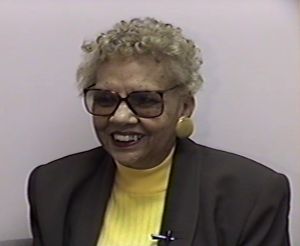
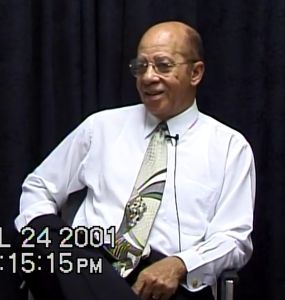
- Oral history interview with Abraham Peeler (Oral histories)
- Oral history interview with Angeline and S. C. Smith (Part 1) (Oral histories)
- Oral history interview with David Helberg (Oral histories)
- Oral history interview with Howard Holderness (Oral histories)
- Oral history interview with John R. Foster (Oral histories)
- Oral history interview with Owen Lewis (Part 1) (Oral histories)
- Nashville Public Library Digital Collections Portal: Civil Rights (Nashville Public Library)
- Online Manuscript Resources in Southern Women's History (Manuscript, Archives, and Rare Books Library (Emory University))
- Papers of Justice Tom C. Clark: Civil Liberties and Civil Rights Cases of the U.S. Supreme Court (Tarlton Law Library (University of Texas))
- Docket sheet for Brown case (Dockets)
- Draft of per curium opinion concerning State of Kansas' failure to defend (Case files)
- Justice Clark's handwritten notes from oral argument (Case files)
- Law clerk's recommendations for segregation decree (Case files)
- Memorandum from Justice Frankfurter regarding "The Segregation Cases" (Case files)
- Memorandum from Justice Frankfurter to court discussing case (Case files)
- "Segregation Research Report" prepared by law clerks (Case files)
- Sheet with oral argument schedule and notation of briefs filed with the court (Case files)
- Summary of Brown case (Memorandums)
- Rev. Joseph A. DeLaine Papers ca. 1918-2000 (University of South Carolina University Libraries Digital Collections)
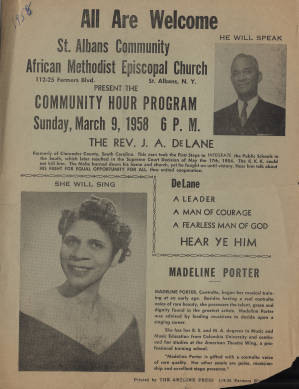
- Flyer, 1958 Mar. 9, (St. Albans, N.Y.), All Are Welcome…, St. Albans Community A.M.E. Church (Texts (document genres))
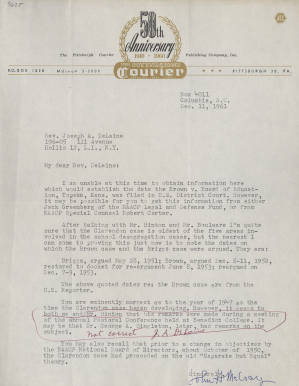
- Letter, 1961 Dec. 11, (Columbia, S.C.), John H. McCray, to Joseph A. DeLaine, Sr., (Hollis, Long Island, N.Y.) (Letters (correspondence))
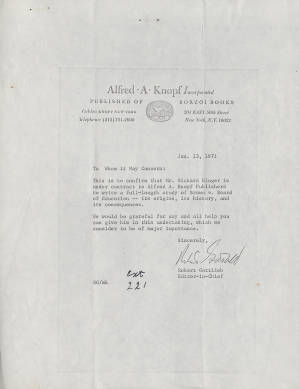
- Letter, 1971 Jan. 31, (New York, N.Y.), Robert Gottlieb, To Whom it May Concern (Letters (correspondence))
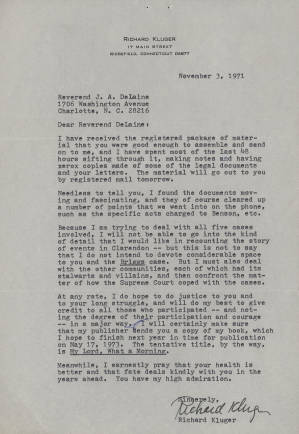
- Letter, 1971 Nov. 3, (Ridgefield, C.T.), Richard Kluger, to Joseph A. DeLaine, Sr., (Charlotte, N.C.) (Letters (correspondence))
- Letter, 1971 Nov. 8, (Charlotte, N.C.), Joseph A. DeLaine, Sr., to Richard Kluger, [Ridgefield, C.T.] (Letters (correspondence))
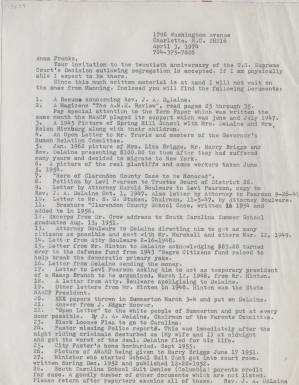
- Letter, 1974 Apr. 3, (Charlotte, N.C.), Joseph A. DeLaine, Sr., to Anna Franks (Letters (correspondence))
- Letter, 1974 May 10, (New York, N.Y.), Harry J. McNeill, to Joseph A. DeLaine, Sr., (Upper Montclair, N.J.) (Letters (correspondence))
- Letter, 1979 May 1, (Columbia, S.C.), Isaac W. Williams, to Mrs. [Mattie] DeLaine, (Charlotte, N.C.) (Letters (correspondence))
- Letter, 1979 May 8, (New York, N.Y.), Louise Frillmann, to Mrs. [Mattie] DeLaine, (Charlotte, N.C.) (Letters (correspondence))
- Program, 1979 May 17, (Washington, D.C.), Brown v. Board of Education, White House, President Jimmy Carter (Programs)
- Speech, [1957], The Decision of May 17, 1954, Joseph A. DeLaine, Sr. (Speeches)
- Speech, 1974 May 17, Cronology [sic] of Events Leading to Inviting the NAACP into Clarendon County, Joseph A. DeLaine, Sr., to 20th Anniversary Celebrating the U.S. Supreme Court's Decision Outlawing Segregation in Public Schools of America, (New York, N.Y.) (Speeches)
- Telegram, 1979 May 10, (Middleton, V.A.), Louis Martin, to Mrs. [Mattie] DeLaine, (Charlotte, N.C.) (Telegrams)
- Telegram, 1984 Feb. 28, (New York, N.Y.), Jack Greenberg, to Mrs. Mattie DeLaine, (Charlotte, N.C.) (Telegrams)
- With an Even Hand: Brown vs. Board at Fifty (Library of Congress)
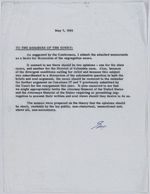
- Earl Warren to members of the Court, May 7, 1954 (Memorandums)
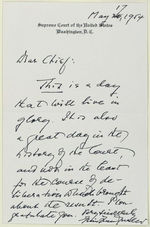
- Felix Frankfurter to Earl Warren, May 17, 1954 (Letters (correspondence))
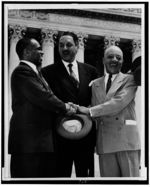
- George E. C. Hayes, Thurgood Marshall, and James M. Nabrit congratulating each other (Black-and-white photographs)
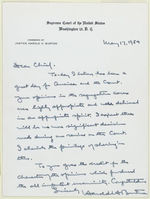
- Harold H. Burton to Earl Warren, May 17, 1954 (Letters (correspondence))
- Harold P. [sic] Boulware, Thurgood Marshall, and Spottswood W. Robinson III confer at the Supreme Court prior to presenting arguments against segregation in schools during Brown v. Board of Education case (Black-and-white photographs)
- I'm eight. I was born on the day of the Supreme Court decision (Editorial cartoons)
- I think this is rather a sad sort of thing... (Editorial cartoons)
- Linda Brown Smith, Ethel Louise Belton Brown, Harry Briggs, Jr., and Spottswood Bolling, Jr. during press conference at Hotel Americana (Group portraits)
- Mrs. Nettie Hunt, sitting on steps of Supreme Court, holding newspaper, explaining to her daughter Nikie the meaning of the Supreme Court's decision banning school segregation (Group portraits)
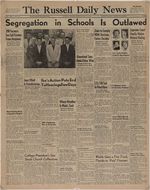
- The Russell Daily News (Russell, Kansas), Monday, May 17, 1954 (Newspapers)
- Save Brown vs. Board of Education : build the new civil rights movement (Posters)
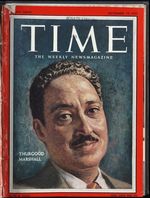
- Time magazine, September 19, 1955. Cover (Magazines (periodicals))
- Waiting for courtroom seats (Photographic prints)
- William Douglas to Earl Warren, May 11, 1954 (Letters (correspondence))
- William L. Patterson, Executive Secretary of the Civil Rights Congress, to Walter White congratulating White on the NAACP's victory in Brown v. Board of Education, May 17, 1954 (Telegrams)
- WSB-TV Newsfilm Collection (Walter J. Brown Media Archives and Peabody Awards Collection)
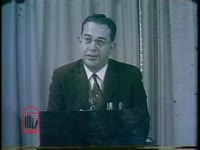
- WSB-TV newsfilm clip of Governor Ernest Vandiver commenting on the actions of Attorney General Robert Kennedy in the Prince Edward County school case, Atlanta, Georgia, 1961 May 9 (Moving images)
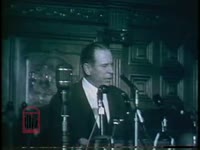
- WSB-TV newsfilm clip of governor Marvin Griffin addressing the General Assembly on segregation and keeping public schools open, Atlanta, Georgia, 1956 (Moving images)
Educator Resources
- Amistad Digital Resource for Teaching African American History (Columbia Center for Digital Research and Scholarship)
- Teachers' Domain Civil Rights Special Collection (WGBH Educational Foundation)
- Brown : a landmark case (Instructional materials)
- Brown reactions : Black educators (Instructional materials)
- Brown reactions : editorials (Instructional materials)
- Brown reactions: Judge Brady (Instructional materials)
- Brown reactions : Zora Neale Hurston (Instructional materials)
- Documenting Brown 5 : Brown v. Board of Education, 1954 (Instructional materials)
- Documenting Brown 6 : Brown v. Board of Education, 1955 (Instructional materials)
- Documenting Brown 7 : Civil Rights Act of 1964 (Instructional materials)
- Little Rock Nine (Instructional materials)
- The road to Brown (Instructional materials)
- Simple justice 3 : the trial begins (Instructional materials)
- Simple justice 4 : arguing the Fourteenth Amendment (Instructional materials)
- Simple justice 5 : Marshall's closing statement (Instructional materials)
- Simple justice 6 : Justice Warren reads the decision (Instructional materials)
- Teaching with Historic Places (National Park Service)